We are Big Score

  • Big Score No. 3

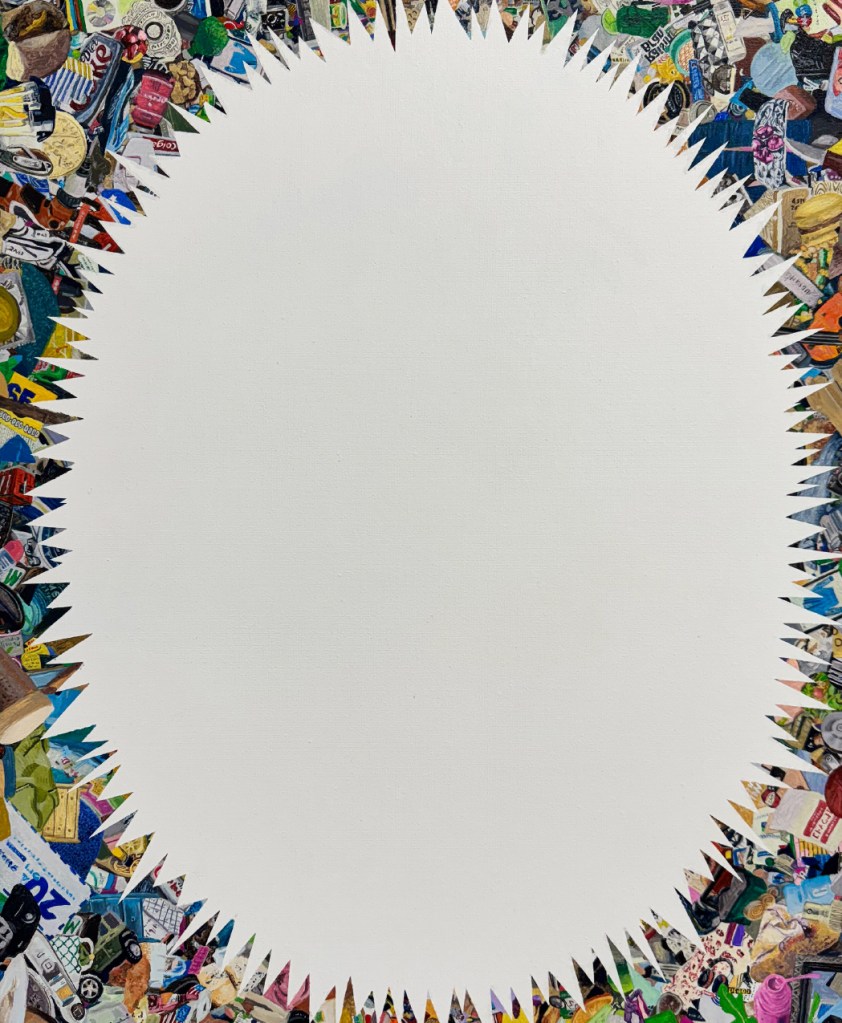
    Embrace the Void. It’s no place to build a home, but somewhere anyone who aspires to create art will necessarily endure a stay of uncertain duration. Big Score No. 3 has arrived… with cover painting, “Aah,” by Tom Friedman.

    Mark your calendars: our launch will be on Saturday, 10/10, at Gallery 198 in Brooklyn from 6:30 to 9 p.m., featuring readings by Ellen Whiteside, Matilda Lin Berke, Robert Frankel, Diane Mehta, Matt Proctor, Damon Pham, Joshua Chaplinsky, and Cleo Aukland.

    You can subscribe to or make a single issue purchase of Big Score here. Best way there is to support our mission of compensating up-and-coming writers decently for their work, evaluating submissions independent of platforms, and standing by the value of printed matter.


    What’s in Big Score No. 3:

    • The Casino Flooding Beneath the Gospel of Luck, a poem by David Anson Lee
    • Requiem for the Angiospermae of Delney-9, a short story by Robert Frankel

      This is what we know: Delney-9 was so distant and remote, it was more likely to be missed than ever found; it was found by a survey drone gone so hopelessly astray the data was ignored for a century; its readings were so provocative—so heterodox—that, for the first time in a half-millennia, there was tangible excitement amongst the guilds and corporate colloquies; that, upon our approach, the expedition leader noted its optimal location in the star system’s Goldilocks zone and expressed a subtle note of doubt about its excavation; that, returning from the first ground surveys, two away teams failed to sabotage the mining equipment because of the third and were summarily tried and euthanized for treason.

      Its system was bountiful with natural resources, and Delney-9 was especially rich in untapped bismuth and osmium. Winged beasts frocked with meter-long plumage soared through crystalline skies tinged pink. Their shadows cut the glimmer of waterways as silver and serpentine as spilled mercury to reveal the glittering motion of fluorescent invertebrates within. Diamond-peaked mountains, the result of some prehistoric cataclysm, pierced the clouds. We can direct you to any simroom, and you could find yourself on Delney-9. Perhaps some of this would awe you.

      But the true wonder of Delney-9 was the singing flowers.
    • Dead Shoes, a poem by Diane Mehta
    • Hysteria in Twee: Wes Anderson and the Disappearing Tangible, a critical essay by Matt Proctor

      Growing up in Texas, Wes Anderson must have been ostracized or alienated for his aesthetic particularities, or that’s what I imagine. He went to private school but the landscape of Houston mega-freeways was probably not where the ur-affected, nitpicking micromanager par excellence director of The French Dispatch (2021) imagined the fable of his life playing out. As soon as he could, Anderson got out of there for L.A. Then as soon as he could get out of L.A., he went to NYC. Then, as soon as he could get out of NYC, he went everywhere else. Is there a pattern here? I don’t know, I’m really asking.

      A part of me wanted to believe when I heard the news that global citizen Wes Anderson had been trapped in an elevator in Los Angeles with James L. Brooks and Luke Wilson after a 30th anniversary screening of his first film Bottle Rocket (produced in 1996 by Brooks and co-starring Wilson) that it was karma for his having seemingly avoided the guys who were his roots since basically the new millennium: he last worked with Wilson on The Royal Tenenbaums released in 2001, and the only film of Anderson’s that Brooks produced was the first, when the elder screenwriter/director served as a sort of Hollywood doula to ‘the boys’ as he called them back then. Now they were stuck on an elevator together in what I don’t think I’m being overdramatic by calling a decaying dystopian Hollywood, almost as if the celebrated director were some pharaoh in danger of getting buried alive with his servants (I know, I know: Brooks was his first patron, not his servant, but allow me the allegory, OK? I’m working on something here, I have ambitions for this thing).

      It was following Tenebaums that Wes Anderson fled from the United States, and his career ever since has appeared as a rebuke to his place of origin, a sort of a ‘Fuck you to the old man’ as perhaps his most celebrated character, Gene Hackman’s Royal Tenenbaum, might say. This trip to Hollywood on the anniversary of his 30th year as a director figured as a Prodigal Son Returning Home moment. In addition to the victory lap screenings at the Motion Picture Academy, he was feted with a retrospective concert of music from his films at the Hollywood Bowl, which featured an all-star cast of collaborators, including Bill Murray and Jason Schwartzman. Notably missing were any of the Wilsons, with whom he came up in an apartment in Dallas, Texas. 
    • Communion, a poem by Cela Xiè
    • [soluble fish], a poem by Timothy Ashley Leo
    • Taddies, a short story by Joshua Chaplinsky

      Uncle Pha was the first to arrive pondside. He squatted next to the large, flat stone he’d dragged to the water’s edge, wearing nothing but his breechcloth, the handle of his favorite mallet gripped in a calloused palm.

      The rest of the village knew not to interrupt this moment—a personal ritual nested within the greater scope of tradition. An opportunity to acknowledge stillness before the ensuing chaos.

      Uncle claimed he could hear the approaching rumble of the taddies days before their arrival. A tsunami of cold, slippery flesh bearing down on the village. He’d put a cauliflower ear to the mud and listen, like a healer verifying the faintest murmur of a heart.

      “Soon,” he’d say with a childlike glint in his eyes. His excitement was contagious, jumping from face to face, grin to grin. The little ones brimmed with awe. They’d never known him to be wrong. They were too young. They’d lay their heads against the ground in respectful imitation, exclaiming that they, too, could hear the rumble, just like Uncle.

      Every year was the same. During the rainy season, a school of fully developed larvae rode the overflow from the vernal pools, traversing an ephemeral stream of churning milt-froth and discarded yolk-sacs down toward the pond, where they were corralled by the damming of the outflow. He-tads and she-tads fresh from the spawning ground, gender indeterminate pending their final transformation, when the females would grow to dwarf their diminutive counterparts.

      But first they’d have to survive the gauntlet of the Spring Harvest.
    • Rite of Spring, a poem by Benjamin Bartu
    • In the Archives of Queer Fiction, a critical essay by A.L. Clausen

      In the belly of the Lesbian Herstory Archives (LHA)—past the library in the front room, before the well-loved kitchen, and beneath the Yellow Wallpaper room on the floor above—there lounge bookcases full of pulp fiction. My fellow intern and I are merely the latest in a long line of archivettes to comb through these vintage titles. Pulp by pulp, we deshelve the fruits of the paperback revolution, their bindings losing heart in our hands. Our duties, however, lie in the digital: scanning covers, back and front, and the short, sultry teasers hiding within.


      “The strange, erotic compulsions that drive one woman into the arms of another…”  —The One Between by Arthur Aldon (1962)

      Each novel is a surreal encounter. Their covers are scandalously sapphic, featuring white women stripped down to lingerie, or nothing at all; and yet, they were once sold in drugstores and bus terminals alike. With their spines squatting on the table, their pages of unbleached wood pulp laid bare, I wonder if the archive is not also a mausoleum. For here lies one great contradiction: casual, cheap reads starring Women-Loving-Women (WLW) sold in the red depths of the Lavender scare. How can there be lesbian literature from seventy years past, when today, the likes of Malinda Lo’s Last Night at the Telegraph Club are banned from so many shelves? 
    • Beast Magic, a poem by Ellen Whiteside
    • Good Girls, a short story by DC Corvino

      I only start calling my wife a good girl after she cheats on me, after I move into the office because we can’t afford to break the lease, after the divorce papers are signed but not notarized, after we fight and cry and get too high and I tell her I hate how we never got to try all those things we talked around, playing chicken with our desires—impact play, quickies out in the wild, the threesome we both wanted and neither would admit to—and we hate-fuck and make the list of all the things we lied about wanting. “You owe me this,” I say, and she thinks it’s hot, this assertive energy we’d never explored because I thought she was repressed and she thought I was frigid, because she couldn’t tell the difference between ice and stone, and maybe she wouldn’t have cheated on me if I’d grabbed her hips like this before, but it’s too late, so we say our goodbyes by fucking in all the ways we never did before, back arched, hair pulled, throat deep and gagging on one dildo while I shove the other up her tight little ass and we talk about how we’re going out with a bang, searching for another girl’s dick to suck together.
    • Mirror, Mirror, a critical essay by Matilda Lin Berke

      I have a picture of myself reflected in the big windows of New York Bar, superimposed against the famous Tokyo skyline, which (I hate to tell you) looks like every other sparkling cosmopolis from fifty-two floors up, in snapshot stasis. S stands right out of frame, conspicuously absent. He’d flown twelve hours from Los Angeles just to discover that we were inextricably on the rocks: a fact I’d been trying to defer for the better part of a year. 

      The process of admitting these things is uniquely hard when you’re young—when a college relationship founded on a high school friendship means that a person has, in total, inhabited almost half of your life. 

      It’s a long, long, lonely way down. 
    • Vikings, a short story by Cleo Aukland

      In mind today there’s a blanket sea, spied from a window with white wooden frames, mottled glass in the upper right pane. The sea is a shimmering thing, gosh gorgeous, diamonds on the blued surface and you wonder if the creatures swimming in it know how lucky they are to catch gems on their backs. Let me tell you: it’s a jubilant blue, ultramarine, sewed with salt and cresting over and over and over. Sky sister, and the only difference is the textured paintbrush which makes the ocean creased.

      There are islands too, hosts to tall pines and balsams and firs which drop needles that become soft underfoot. Then the stones before the trees meet the water, sometimes scores of them making up gray rocky beaches, sometimes large, flat, sandy ones, sometimes copper-colored craggy ones with pearly seaweed sucked on and barnacles below, and the tide laps over them to paint lines that change with each wave. On occasion it’s odd to think that the forest should end so abruptly at the ocean, but it does.

      And as for the unnatural, there are the boats
      .

  • Announcing Big Score’s Substack with Justin Kamp’s essay from our debut issue, “The Swimmer in the City”

    We’ve crossed the unofficial halfway point of summer, so what better time than now to read Justin Kamp’s living history of public pools all around New York City?

    Look to our Substack for more work from Big Score & co. soon.

    Read here: https://bigscorelit.substack.com/p/the-swimmer-in-the-city

  • Final call for submissions to Big Score No. 3

    We close at midnight eastern tomorrow night, Tuesday, July 1st

    Check out our About page if you have questions about guidelines… and spread the word?

  • We have opened for submissions

    And will remain that way until 7/1/26, or such time as we receive 200+ submissions for both poetry and prose.

  • Announcing our next submission window — w. a poem

    Details on our submission window for the Fall issue follow


    THE RANSOM NOTE or Big Score Lit: An Abstraction Manifesto


    We’re called Big Score, like the ransacking of a safe,
    Like we use a surgeon’s most delicate tools to strike
    Imperial metal until monoliths crack, and outpours
    Mouthfuls of searing, screaming gold light.
    We are the original sort of sort— if it tastes like
    It went the long way back in the dead of night: chances are
    We’re listening. If you wrestle to keep your soul encased
    In your own body: hit our line. If the animals keep
    Poking their antlers through your skylight— hold your
    Breath, walk slow, and try to yank something up
    For us to use: we’re starving. It can be quiet
    As a violin in a locked-up room or we could have you
    Kidnap a holler and deliver it by parachute.
    We believe in: More and Sooner, later has long since arrived.
    We want to: sack the joint and hand you the blueprints that say:
    Walk one foot and collect your winnings— the bravery was
    Just in coming. But, for god’s sake: keep your mask on.
    We are well trained in recognizing a comrade
    By how they vanish into the moment…
    And, above all, we want to look good for the paper.
    Call us sentimentalists or a low-level mob hitman
    Who doesn’t want to face the epoch’s ending, but we still think
    there is healthy rage in this world.


    – Andres Cordoba, Poetry Editor for Big Score


    We will be opening for submissions again, both poetry and prose, at midnight on May 24th, 2026, and will remain open until July 1st, 2026, or once we reach ~200 submissions.

    Big Score No. 3 is slated to publish in October 2026.

    For our specific submission guidelines/how to, read here.

  • Subscribe to the print mag… or donate $1?

    Greetings. If you’re receiving notice of this dispatch, you signed up for Big Score website’s mailing list. We thank you for that, and appreciate your attention to our work.

    We did want to encourage anyone on this list to subscribe to our print mag for $36/year. It’s a two-step process: the first page requests pertinent subscriber info & the second payment information. This is the best way to support us & ensure we are able to continue to do this work (while also reaping the fruits of our literary labors).


    If the budget is tight — and heaven knows, we’ve been there — but you nevertheless feel well-disposed toward a lit mag that lives the values of reading submissions blind, compensating writers decently, and fostering print culture, you can still help us out plenty by donating $1. Yes… that’s one dollar, no hyperbole.

    In brief, our fiscal sponsor, Fractured Atlas, until Friday, 5/8/26 at midnight, is hosting what amounts to a raffle to benefit outfits like ours: they will award 1k to a magazine based off tickets given for donations of any amount, which can be made here: https://fundraising.fracturedatlas.org/big-score-lit/general_support

    That is why we’re requesting donations of only $1. Once you’ve clicked thru the link, all you have to do is go to the fourth box on the right and customize the donation amount. Each will give Big Score another chance at 1k, which would indeed make a big difference for a shoestring project like ours, and help to perpetuate our mission.

    We thank you, in any case, for reading this note to the end, and expect to hear more from us again soon: an official announcement of our submission window will follow in another day or two. If you want a sneak peek, take a look at our ‘About’ page, which has already been updated with the new guidelines.

  • Big Score No. 2 launch party

    Join us on Sat., March 21st in Brooklyn at Gallery 198 (198 24th St.), from 6 – 9 p.m.


    The launch for Big Score No. 2 is a little over a week away.

    We’ll be gathering at Gallery 198 starting at around 6 p.m., with readings kicking off at 7 p.m.


    Feat.

    Matilda Lin Berke
    Moises Ramirez
    Bo Lewis
    Michael Chang
    Felicia A. Rivers
    &
    Joshua Furst

    with musical performances by
    Noah K & Giacomo Merega


    New issue + limited copies Big Score No. 1 will be available at the event.


    * should be a good time *

  • Big Score No. 2

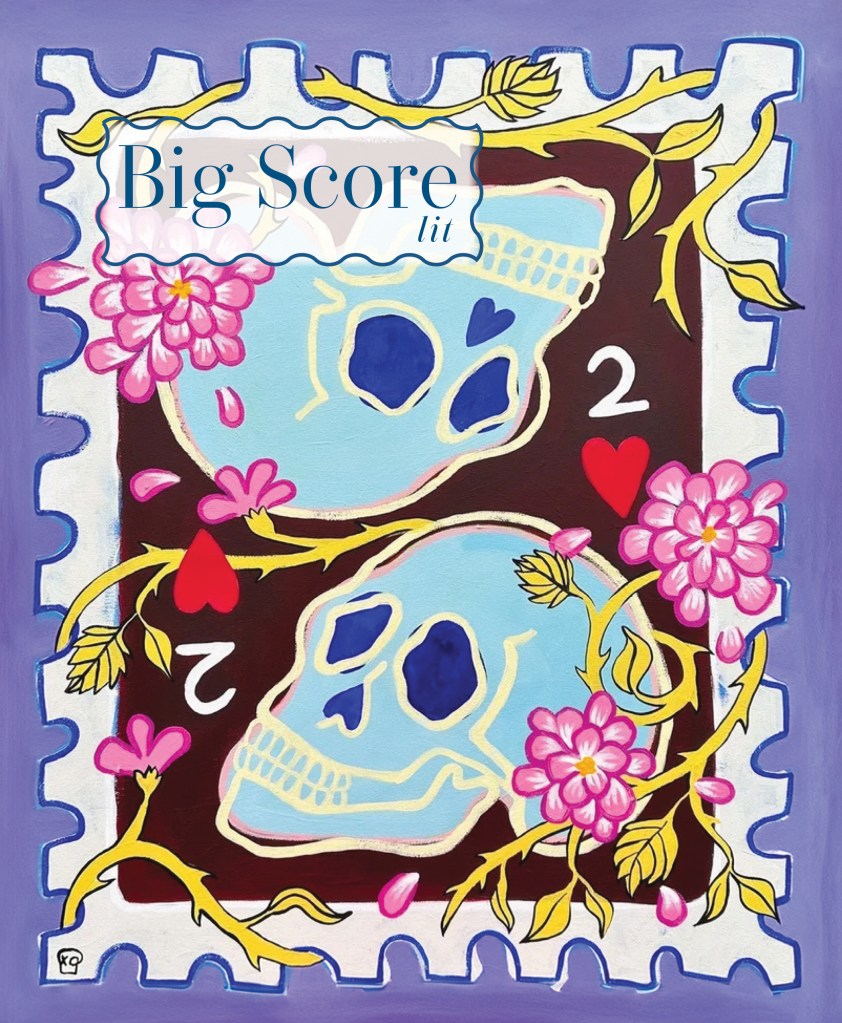
    Big Score No. 2 is going to the presses… with cover painting, “Star Crossed Hearts,” by Sophie Rae.

    We will be bringing this one into the world in Baltimore. Specifically, at the AWP, where Big Score is set to share a table (T338) with our friends at Excerpt Magazine. 

    Launch party in Brooklyn details TBD — likely mid-to-late March.

    You can subscribe to or make a single issue purchase of Big Score here at right around the cost of two months of Netflix. We’d appreciate your support toward our mission of compensating up-and-coming writers decently for their work, toward evaluating work independent of platforms, toward standing by the value of printed matter.

    & if you are sympathetic to what we’re doing here & you’ve got some signal to give, we’d definitely appreciate a little boost.

    A preview of Big Score No. 2:

    • Scrimshaw I, a poem by Matilda Lin Berke
    • The Crewe, a short story by Felicia A. Rivers

      LolaLuz hit the streets, slapping her big winky-smiley stickers on the skin of the city. She started with batches of the traditional happy, yellow faces, then quickly branched out into pink, green, blue, purple, black, white, and orange. A grin here. A kissy-wink there. She slapped them on mailboxes, light standards, and telephone poles, blanketing Old City with her little exhortations of joy. Until a woman with blonde bangs and a Burberry coat (“I’m the Vice President of the Old City Civics Association, dontchaknow!”) caught her in the act and flagged down a passing police cruiser. Broken and busted—damn it! Rule #1 of Grrr-illa Street Art: Remain anonymous. Rule #1a: Don’t get caught. LolaLuz was saddled with a $300 fine and a big stinking sack of what-next?
    • GEESE CONCERT, OR MEN’S RIGHTS RALLY, a poem by MICHAEL CHANG
    • A Bunny at the Jackrabbit, a short story by E.J. Leroy

      When Crystal responded to the bell for the lineup, she expected to find a man sitting on the sofa with arms folded across his chest, eyes on the merchandise. Instead, the sofa was occupied by a petite olive-skinned woman with long, straight dark hair, a prominent nose, and leopard print glasses. She sat upright with her palms pushed into the sofa as though she was trying to keep it from swallowing her. A duffel bag lay on the floor at her feet. Crystal did her best to hide her surprise. The Jackrabbit had only recently allowed female clients, and few took advantage of the change in company policy. Although Crystal had marketed herself as being “female friendly,” she had never stood in a lineup for one.

      Crystal was first in line. She clasped her hands behind her back, stepped forward, and introduced herself.

      Before she had a chance to step back, the woman enveloped by the giant sofa pointed at her and said, “You. I’ll take you, if that’s all right.”
    • Illnesses, a poem by Katherine Cart
    • Bell Theories, a poem by Chiwenite Onyekwelu
    • I/a verb/you, a poem by Dmitry Blizniuk and translated from Ukrainian by Sergey Gersimov
    • cigarettes and madeleines, a travelogue, essay by Moises Ramirez

      I witnessed an array of madness in the behavior and demeanor of the temporary residents of this place of leisure. A man with a suitcase, his face struggling to contain a frenzied look, began to add layers of clothing over the extensive clothing he was already wearing. First a dress, then a sweater, then another dress, now a blazer on top of all the prior embellishments. I felt the garden must have been perfumed by a psychedelic mist, and perhaps I wasn’t really seeing what I was seeing. Perhaps a tear in the fabric of the visual universe had revealed itself, as manifested by the man with too many clothes in the park in front of me.
    • Time Machine parenthesis Sam Elliott voice close parentheses, a poem by Will Keever
    • Dutch Masters, a short story by Bo Lewis

      Philip and David stand in the Great Hall of the Metropolitan Museum of Art, studying an unfolded floorplan whose edges are furred with wear. It is so humid outside that David’s tortoise-shell glasses fogged when they came through the entrance. Their skin is still clammy from the crosstown walk, and David leans against Philip, as if with enough shared heat their bodies might fuse. Closing his eyes, David nuzzles Philip’s moisture-wicking shirt, a pale blue number more suited to the Appalachian Trail than Fifth Avenue, and inhales the heady scent, which David has teasingly dubbed “eau de flyover”: a mix of Old Spice, Barbasol, and sweat. Summer is almost over. This knowledge glows along the horizon of David’s awareness—more a presence than a thought—and he brushes it from his mind.

      Philip says, “Let’s play house.”

      “Which room?”

      “You choose.”
    • Hamster, a poem by Damon Pham
    • In Flux: on the Archive and Memory, October – November 2023, an essay by Loisa Fenichell

      I. On the Archive and the Letter

      I hold at once multiple visions of the archive. In philosopher Jacques Derrida’s Archive Fever, he reminds us that the word comes from “the Greek arkheion . . . those who commanded . . . It is thus . . . in this house arrest . . . that archives take places.” Derrida is invested in deconstructing hierarchies and positions of power; in the case of Archive Fever, he explores how the archive was originally constructed and sheltered by “citizens who . . . held . . . political power,” and which ultimately continues to be a place of power today. Another French philosopher, Michael Foucault, provides a similar definition in his essay “The Historical a priori and the Archive,” from his book Archeology of Knowledge: “The archive is first the law of what can be said, the system that governs the appearance of statements as unique events.” The quintessential archive is not a public library or a space accessible to the people.
    • Shechita, a poem by Shira Haus
    • To Believe in this Living, a short story by Joshua Furst

      Across the street, in the new building on Bergen, shadows move behind the clouds reflected off the plate glass windows. Flashes of color. People, maybe. Back before the family living on the third floor fled to wherever people like them have gone, she used to see children squash themselves against the surface. Those grubby hands. Mouths expanding like blowfish against the glass. Sometimes, after the sunset, when the light inside was brighter than that out on the street, she counted time by watching those who forgot to pull their blinds go about their lives. They all seemed so stable, so settled. When she wasn’t wishing she could be them, she pitied them. One night, smoking out on the fire escape like she is now, daring it to collapse under her feet, she watched one of the tech bros—or advertising bros or lawyer bros or whoever they are who own half the apartments there—fuck his Tinder date right up against the window. She could swear he’d known she was watching. He’d stared right at her while he came, held her gaze, caught her. These people. Are any of them still there? If they could go out into the world again, would they? Would she? Today, she thinks, maybe she would, if only because the rich fucks like them aren’t here.

      But that’s an evil thought.

      Anyway, she’s not going anywhere. Even in good times it’s not safe to go outdoors. There be demons there. Or people you know—people who know you—which is often worse.
    • Floral Clock Time, a poem by Susan Terris
    • Public Domain Poetry! surprise poem by surprise poet in the public domain
  • Poetry subs for Spring ’26 issue close on Dec. 15th (if not before!)

    Without so much fanfare, we’ve opened for poetry subs for our Spring issue, and will remain open until Dec. 15th, or until such time as we hit 300 subs.

    Currently, at around 125 and digging what we have received, thank you.

    More info here.

  • Big Score No. 1

    Issue launch on Sun., Oct. 12th at Gallery 198, 5 – 8 p.m. — Join us?

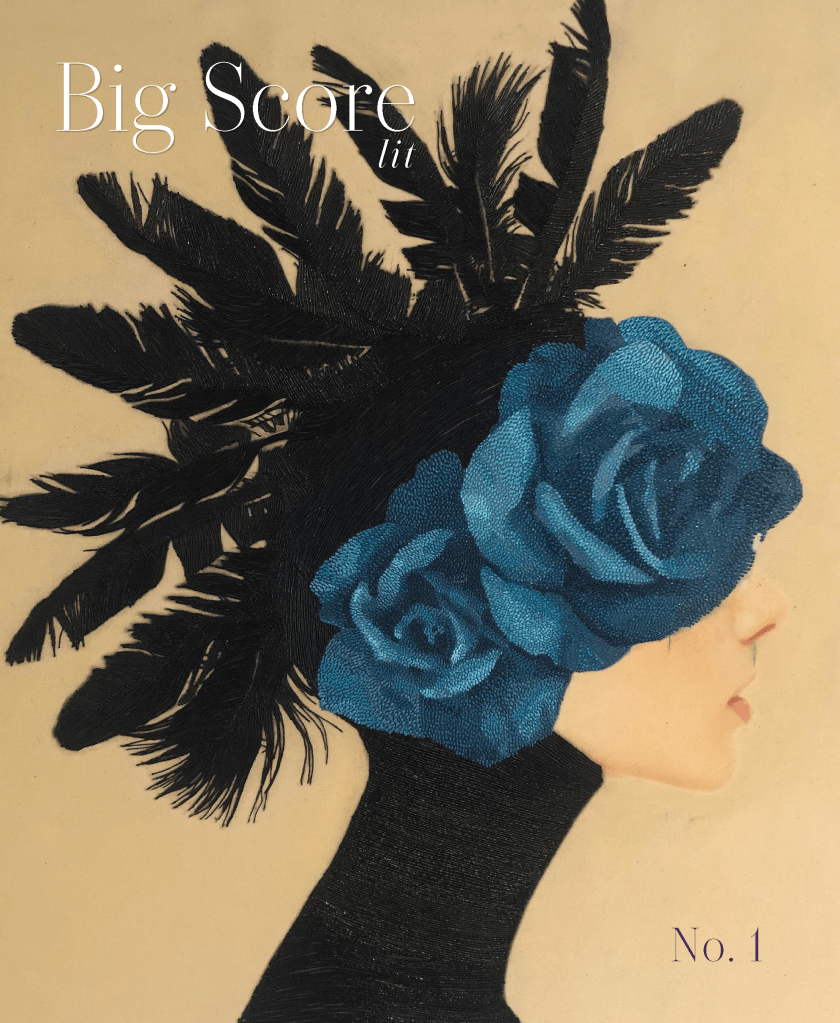
    “Lady Peacock” a painting by Rachel Daly, and the cover image for Big Score No. 1

    Big Score No. 1 cometh…

    Our launch party is set for next Sunday, October 12th, at Gallery 198 in Sunset Park, from 5 – 8 pm. Readings by Cleo Qian, K.P. Taylor, Justin Kamp, and Andres Cordoba. With music from Will Chang. There is a bar, and the current Gallery 198 exhibition features work by AJ Springer. It will be a good time.

    You can subscribe to or make a single issue purchase of Big Score here, which naturally is the best way to support what we’re doing.

    A preview of what No. 1 contains:

    • Dilettantes, a short story by Adora Svitak 

      When we met in college, he was a poet who studied politics. It had been a long time since he had written a poem. While he worked at a public-interest law firm, I pulled novels from my backpack in cafes where disdainful baristas whisked $9 matcha lattes. Reading novels was not my job; I was supposed to be turning my dissertation into a book about modern heterosexuality. I made little progress most days, sitting in noisy cafes and texting friends who had day jobs to ask if they had evening plans.

    • Calf, a poem by Loisa Fenichell
    • Dumpster Fries v. the Monster, a short story by Douglas W. Milliken

      It was one of those late summer mornings where the air itself was gray and lifeless as old burger meat yet nevertheless steamy with oppression (think of the moist breath of a dog who won’t get its panting stink-mouth out of your face) even while the dirt-colored birds were still in the process of waking up to announce their useless wakefulness. You know the kind of day I’m talking about. It sucked before it’d even begun. We were in that old wreck of a house we’d found standing all alone in the brownfields out by the airport, just Jaylee and me packed into a corner of one downstairs room in a matted pile of sleeping bags and grungy clothes and girl. It somehow was and wasn’t exactly as bad as it sounds. Jaylee’d gotten her cast off a few days before but still had some nasty Frankenstein shit stitched up and down her thigh from knee to hip, and she was supposed to be doing physical therapy, too, but that obviously was not going to happen as long as she had to get through each miserable day as a wounded member of the world outside (as opposed to inside) the hospital: since it’d been her asshole stepdad who’d spelled her leg’s ruin with the front end of his Crown Vic, going home was not an option, and since I lost the gamble of revealing to my god-fearing folks that Jaylee was my girl and she needed a place to stay, we were the both of us now unhoused and too focused on surviving one day to the next to worry much about PT sessions or exercises or the dosage and frequency of Jaylee’s cache of fentanyl patches. We were teenagers without homes is all I’m trying to say. Would you be keeping appointments if you’d been us and we’d been you?
    • Barbarians at the Gates?, a poem by Brad Rose
    • An Anatomical Dissection of Depression in a Bo[d]y Offering Itself As Curriculum, a poem by Ismail Yusuf Olumoh
    • Shells, a short story by Wilhemina Austin

      Ralston turned the wheelchair to the right, reached for a cockle shell, pink-streaked. Then he grabbed another with bands of yellow. He was full of the setting sun’s fire. He halted to swoop up one shell after another. He sorted and dismissed, the same as he sorted through the people walking over the sand past us, his voice never low enough. He took the strain of the wheelchair with ease, broad-shouldered as he was, not all that tall, his back well-muscled.

    • The Swimmer in the City: Civics and Semiotics at the Public Pool, a critical essay by Justin Kamp

      Some of my most treasured hours in New York have been spent on the concrete deck of a public pool. My favorite time is just after 5 pm, in the part of midsummer when the afternoon seems impossibly extended, when the daylight idles and eddies before night even begins to take shape. My routine is as follows: I come to the pool directly from work, towel and trunk in bag, sweat usually still sheened over my forehead from the crush of the commute. I shower, stroll out, spread my towel in an opportune stretch of sunlight and sprawl, letting the city’s sub-tropics warm me until I’m kiln-brick hot. Then I don my cap and goggles and ease into the water for a half hour of freestyle. After that, it’s an hour of uninterrupted reading as I dry off in the full late sun before the pool closes at 7.

    • Chicago Sonnet #42, a poem by D. A. Hosek
    • Dead Week, a short story by K.P. Taylor

      NIGHT ONE

      Even Rusty, who usually took no small pleasure in barking orders, had grown almost silent.

      “Lenny,” he huffed, “you work all the live freight?”

      “Weren’t nothin’ to work,” Lenny replied.“How ’bout the backstock?”

      “None of that neither.”

      It was the beginning of Dead Week, that seemingly endless stretch of dull nights between Christmas and New Year’s Eve with nothing to do and too many hours to fill doing it. Rusty scanned the backroom, searching desperately for something, anything, for Lenny to do. Every last bag of stuffing had already found its way to the discount rack, and all the bottles of cheap champagne had claimed their places on the endcaps.

      “Ya know what?” Lenny offered, preferring to jump rather than be pushed. “I could head over to Aisle 7. There’s some cans of Friskies and Fancy Feast I could front.”

      “Why don’t you go on over to Aisle 7, Lenny,” Rusty said, as if it had been his idea.

      Lenny made a big show of wheeling an empty U-boat out with him.
    • Oh the Passion, a poem by T.A.R. Wallace
    • When You Become a Witch in a Nigerian Home, a poem by CP Nwankwo
    • When Love Speaks Yoruba and English, a short story by Solape Adetutu Adeyemi

      I.

      I remember the first time I fell in love. It was with a boy who didn’t know how to say I love you in Yoruba. That should have been my first clue that things would break.

      His name was Tobi. We met at a poetry open mic at Terra Kulture in Lagos. I was twenty-two, fresh out of university, clutching my brown leather notebook like it contained my entire worth. I hadn’t written anything good in months, but I needed to be surrounded by people who still believed words could save us.
    • The Things We Hang Onto, a poem by Oladosu Michael Emerald
    • Waiting, a poem by Cleo Xian

Big Score Lit

Brooklyn-based print lit zine, 2x year

skip ↓